
Before even thinking about AI, institutional investors need to solve the problem of data access. But access is a major challenge facing asset managers, asset owners and corporates. For one, data entitlements and secured data sharing among teams proves difficult. Only a quarter of financial organizations can source and manage all their data inputs effectively, according to a report from Worldwide Business Research (WBR) Insights and Rimes1 that included 100 respondents from finance organizations across the U.S. and Canada. To boot, because 35 percent of respondents claimed their organizations struggle to control entitlements and permissioning properly, they could be at added risk during a vendor audit.
In addition, data discovery within organizations is hard, as is data distribution. That’s because there are multiple data sources each financial institution needs that are often siloed. Each investment process relies on data feeds from various vendors, with inconsistent formatting that requires data teams to undertake the laborious process of standardizing it.
All in all, these complexities lead to too many manual steps in data ingestion. Extracting and reconciling data does not fit smoothly into existing workflows. Firms use multiple data providers, with many data feeds, each with vendor connectivity nuances. There’s a dependency on methods of data transfer like FTP that are disconnected from the processes that use the data and further complicate error handling. That ends up limiting data strategy scale.
What’s more, not every data provider supports API connectivity. The widespread use of Excel as a modeling tool also means that end-users are often navigating ungoverned data sources.
Another pain point for financial institutions arises from the dependency on external sources of data, which for buy-side firms includes data vendors and service providers. But each new supplier integration is just the first step, followed by finding and handling the idiosyncrasies present at the dataset level, including non-standard identifiers and formatting. And that’s not just a onetime effort, each dataset requires ongoing attention to data quality.
Amid all these obstacles, there’s an increasing need to make data available for data science and machine learning. First, the data must be brought together in a state ready to use while ensuring there are suitable controls around access and how it’s used.

Financial institutions use many data sources and vendors, but data is typically structured differently across sources and is often incomplete, with differing formats and identifiers. Entire teams are required to clean data manually.
This process can be time-consuming and expensive, thus limiting data accessibility. Institutional investors who are facing pressure to get their data management AI-ready are confronted with another challenge: the data itself isn’t ready, lacking as it does a common semantic layer to model and normalize it across multiple providers, sources, types, and structures.
Of course, as data demands continue to grow, different teams have varying data needs. In addition, financial institutions underutilize the data they currently have, leading to wasted money and resources.
Data from many sources must be extracted manually. Financial institutions end up polling servers for updates instead of using event-driven notifications and API. These queries are wasteful, unnecessarily consuming bandwidth and leading to processing delays. Plus, the disparate data isn’t unified.
Accessing usable data efficiently is a widespread issue for institutional investors given the need for manual extraction and pervasive errors. According to research that data technology provider InterSystems commissioned, 54 percent of the 375 asset management firms surveyed identified eliminating errors as their number one data management challenge.1 Doing so efficiently is another obstacle: though 41 percent of asset managers named responding to business requests in a timely manner as a data management improvement that could drive business, just 3 percent of asset managers said they use data that is five hours old or less for reporting and nearly half admitted to using data more than a day old.
The operational burdens are also large: two-thirds of respondents told InterSystems they require six to nine people to process data to meet business stakeholder needs, and 85 percent said their data teams and IT personnel spend up to half their time servicing data requests from business stakeholders.
That calls for an investment in more sophisticated data management, with 60 percent of investment management firms polled telling Broadridge they plan to increase spending on digital and data analytics in the next two years.2

Given the pressing challenges financial institutions face in accessing and managing their data at scale data for both public and private assets, investing in cloud-native capabilities can serve as a ready solution for consuming and integrating data.
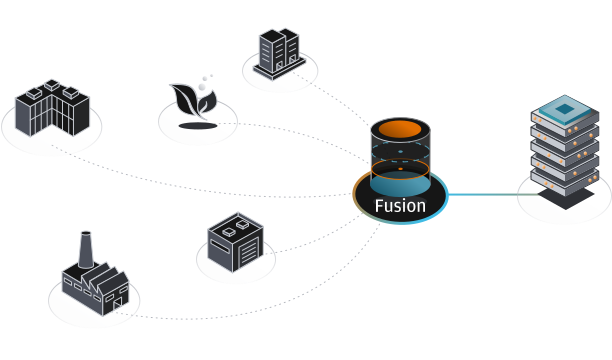
As a leading asset servicing provider, J.P. Morgan uses its expertise and deep understanding of complex client challenges to offer a better way to manage data. Fusion by J.P. Morgan, a data technology solution for institutional investors, provides end-to-end data management, analytics and reporting across the investment lifecycle. The platform seamlessly integrates and combines data from multiple sources into a single data model that delivers the benefits of scale and reduced costs, along with the ability to more easily unlock timely analysis and insights.
Data Mesh, part of the Fusion solution, enables investors to access data across sources via modern distribution channels, including API, Jupyter Notebook and cloud-native channels such as Snowflake and Databricks. Through Data Mesh, investors can simplify their consumption models and accelerate their analytic outcomes and subsequent strategic decisions.
Data discovery is simple in the Fusion Data Catalog, where it’s possible to access data across asset classes, themes and sources including J.P. Morgan and other providers. Today, investors can access their investment data from Custody, Fund Accounting and Middle Office services, such as positions, transactions, holdings and NAV summary. Additionally, Fusion supports diverse data types, including pricing data, private asset valuations, index and benchmarks, ESG data and reference data.
The point-to-point solution also allows asset managers and asset owners to upload data securely into a private catalog and distribute it across their organizations for collaboration. With event-driven notifications, Data Mesh ensures updates aren’t missed, without needing to call the API manually to determine if data is available.
Addressing key challenges and solving data access issues across a firm’s data landscape requires the right technology and expertise. This is where Fusion Data Mesh can help firms take advantage of the cloud’s elasticity and tap into the growth and rapid development in analytics.

The new REST API, Python, FTP and Java SDKs enable investors to easily integrate their data into their workflows or existing applications and develop advanced analytics for a wide range of use cases, from automated reconciliation to investment analysis and reporting.

Investors can access data directly in their Jupyter notebooks using the Fusion Python library, allowing them to jump straight into analysis and work with the data to solve a vast spectrum of use cases with minimal effort.

Fusion is Snowflake and Databricks compatible with Securities Services datasets ready to be extracted directly from cloud instances. Investors using services such as Snowflake and Databricks as an integration layer can directly access J.P. Morgan data regardless of their cloud provider.

The Data Mesh is optimized for developers with new programmatic notification services, self-service tools for app management and authentication, and access to data catalog and data dictionaries through the API and the Fusion UI.
1: Data: A Competitive Differentiator, InterSystems
2: How Asset Managers Turn Complex Data into Actionable Insights, Broadridge
Complete your access to Fusion or talk to our team about your data needs.