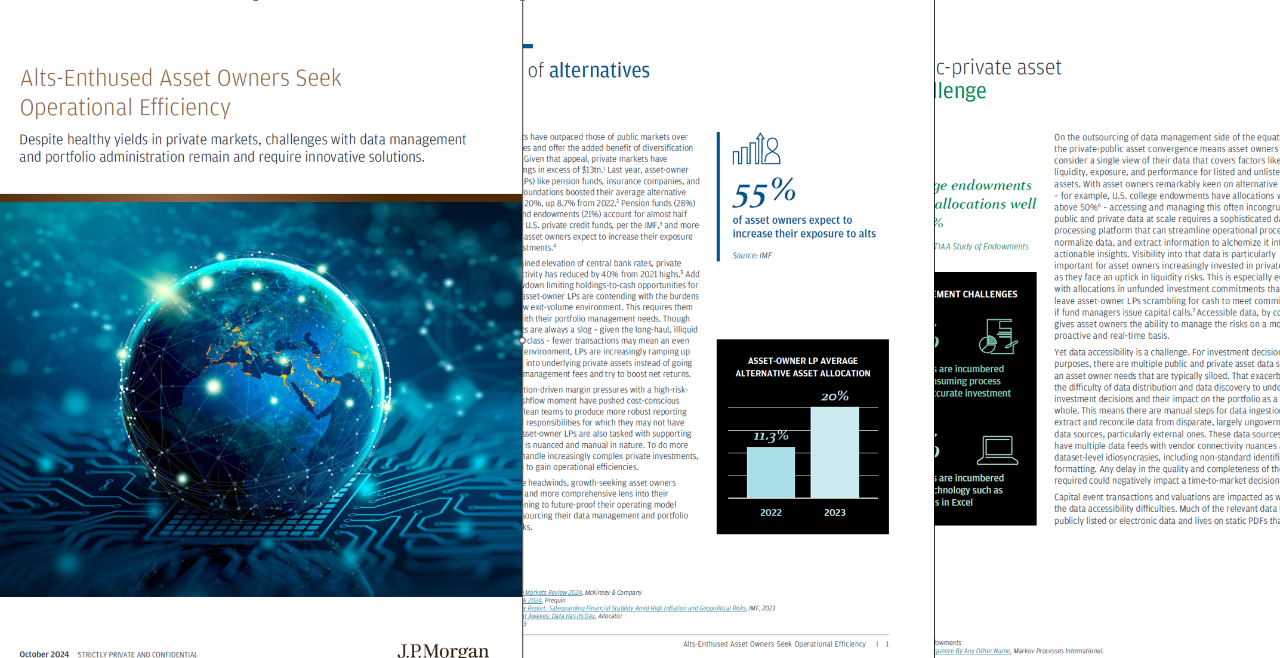

Private investments have outpaced those of public markets over the last two decades and offer the added benefit of diversification and tax efficiency. Given that appeal, private markets have accumulated holdings in excess of $13tn.1 Last year, asset-owner limited partners (LPs) like pension funds, insurance companies, and endowments and foundations boosted their average alternative asset allocation to 20%, up 8.7% from 2022.2 Pension funds (28%) and foundations and endowments (21%) account for almost half the investments in U.S. private credit funds, per the IMF,3 and more than half (55%) of asset owners expect to increase their exposure to alternative investments, according to a worldwide study of 151 alternatives-exposed asset owners conducted by data and software-as-a-service firm Allocator.4
But amid the sustained elevation of central bank rates, private equity new-deal activity has reduced by 40% from 2021 highs.5 Add to that an IPO slowdown limiting holdings-to-cash opportunities for PE investors, and asset-owner LPs are contending with the burdens of a particularly low exit-volume environment. This requires them to be extra agile with their portfolio management needs. Though private investments are always a slog – given the long-haul, illiquid nature of the asset class – fewer transactions may mean an even slower ROI. In this environment, LPs are increasingly ramping up direct investments into underlying private assets instead of going via funds to avoid management fees and try to boost net returns.
Concurrently, inflation-driven margin pressures in a high-risk profile and low-cashflow moment have pushed cost-conscious asset owners with lean teams to produce more robust reporting and take on added responsibilities for which they may not have expertise. These asset-owner LPs are also tasked with supporting an asset class that is nuanced and manual in nature. To do more with less and still handle increasingly complex private investments, asset owners need to gain operational efficiencies.
In the face of these headwinds, growth-seeking asset owners desiring a timelier and more comprehensive lens into their holdings are beginning to future-proof their operating model proactively by outsourcing their data management and portfolio administration tasks.

On the outsourcing of data management side of the equation, the private-public asset convergence means asset owners must consider a single view of their data that covers factors like risk, liquidity, exposure, and performance for listed and unlisted assets. With asset owners remarkably keen on alternative assets – for example, U.S. college endowments have allocations well above 50%6 – accessing and managing this often incongruous public and private data at scale requires a sophisticated data processing platform that can streamline operational processing, normalize data, and extract information to alchemize it into actionable insights. Visibility into that data is particularly important for asset owners increasingly invested in private funds as they face an uptick in liquidity risks. This is especially evident with allocations in unfunded investment commitments that could leave asset-owner LPs scrambling for cash to meet commitments if fund managers issue capital calls.7 Accessible data, by contrast, gives asset owners the ability to manage the risks on a more proactive and real-time basis.
Yet data accessibility is a challenge. For investment decision purposes, there are multiple public and private asset data sources an asset owner needs that are typically siloed. That exacerbates the difficulty of data distribution and data discovery to understand investment decisions and their impact on the portfolio as a whole. This means there are manual steps for data ingestion to extract and reconcile data from disparate, largely ungoverned data sources, particularly external ones. These data sources have multiple data feeds with vendor connectivity nuances and dataset-level idiosyncrasies, including non-standard identifiers and formatting. Any delay in the quality and completeness of the data required could negatively impact a time-to-market decision.
Capital event transactions and valuations are impacted as well by the data accessibility difficulties. Much of the relevant data lacks publicly listed or electronic data and lives on static PDFs that are generated by internal and external sources. To boot, asset owners also have an ingrained dependency on anachronistic data transfer methods like FTP and on Excel spreadsheets as a modeling tool. In terms of data management challenges, almost half of asset owners (46%) cite the time-consuming process of producing accurate investment reporting and slightly less than a third (30%) flag inflexible technology such as complex models in Excel, according to the Allocator study.8 In a signal that data management trends are moving away from these incumbent, outdated methods of data management, more than half of asset owners (57%) have expressed plans to invest in the latest data management technologies in the next 12 months, according to the Allocator study.9
Accelerated data access and analysis are all the more important given that a potential decline in equity valuations may mean an asset owner’s portfolio could become overbalanced in private assets. Beyond the necessity to follow asset allocation guidelines for alternatives, asset owner investment priorities may set in motion the need to rebalance, free up capital for other investments, or diversify into more liquid markets. The increased complexity introduced with the public-private convergence centers data and its management as a priority.
Advances in data management and thus data integrity can improve asset-owner investment operations. Hence the increased urgency to access data that is centralized and normalized with robust data quality, data governance, entitlements, and controls across the ecosystem. In fact, through 2025, 80% of organizations that do not modernize data and analytics governance are expected to fail, per technological research and consulting firm Gartner.10 An outsourced cloud-native data management system could provide a major boost in operational efficiency and performance.

In addition to the data challenges of the public-private asset convergence, the other side of the equation is the asset-owner LPs contending with the inherent lack of transparency in private investments, a hurdle that outsourced portfolio administration could help clear.
Some 80% of general partners (GPs) report that LPs are requesting increased transparency around the performance of their portfolio’s underlying assets, according to a Public Pension Study from the American Investment Council.11 That is especially necessary as elevated interest rates and inflation have staunched multiple expansions, leaving asset-owner LPs to train their sights on margin expansion through more granular portfolio insights and nimble management.
That drive for portfolio transparency comes with added good reason as portfolios grow more complex through the integration of alternatives. Historically, portfolios with assets listed and traded on an exchange were solved for daily using net asset values (NAV) with accounting platforms as the end-all, be-all. That is easier for institutional investors looking to rebalance equities, an asset class for which they can ascertain continuously observable pricing any day the market is open.
The scenario is markedly different for LPs, including alternatives curious asset owners, who struggle to ascertain timely NAVs from GPs that they can then use for reporting, rebalancing, and risk management. This is because private funds have lagged valuations given their standard quarterly reporting structure. Drawdown structures in particular mean a lack of visibility into a GP fund’s underlying investments. To stay on course without a clear look-through into their private investments, asset owners must navigate how to maintain target asset allocation weighting. Because of the lag in GP-supplied NAVs, asset-owner LPs instead rely on estimates triangulated from the previous quarter’s NAVs that the GP provided and more up-to-date financial data.
Recent regulatory and tax changes such as the Foreign Account Tax Compliance Act (FATCA), Common Reporting Standard (CRS), and Partnership Representative (Internal Revenue Code 6223) have only ratcheted up the onus on asset-owner LPs to provide fund-level performance reporting. This makes the prospect of outsourcing portfolio administration tasks all the more attractive.
In a testament to the difficulties of private asset obscurity, LPs named their biggest investment process challenge as “gaining a comprehensive understanding of portfolio exposures and underlying holdings” in a global survey of LPs and asset allocators from Dynamo Software.12 LPs named “document collection and data extraction” as their second-greatest investment process challenge, per Dynamo. As a further indication of their need for clear appraisal of holdings within private funds, the LPs in the Dynamo Survey ranked document and data management, exposure management, cash flow forecasting, and board/committee reporting as their lowest competencies.
To contend with these challenges, some 57% of LPs surveyed this year plan to allocate more money toward technology compared to just 49% last year, according to the Dynamo survey, with portfolio management systems and data automation as their two top focus areas for technology over the next 12 months. Of course, not all problems can be managed in-house: more than a third (37%) of LPs surveyed use third-party software that solves for the commitment pacing producing the desired asset allocation, per Dynamo.
Externalizing portfolio administration functions is of the essence for asset-owner LPs when it comes to obtaining a whole-of-fund view that provides insight into positions and exposures. Almost half (45%) of asset owners are outsourcing NAV calculations and unit pricing, according to the 2023 ValueExchange Asset Owner Transformation Study.13 A whole-of-fund view is increasingly sought after: nearly half (48%) of asset owner respondents noted they are working on adopting new investment book of record (IBOR) solutions to have an up-to-date view of positions and exposures, more than doubling from 21% in 2022, according to the ValueExchange study.
Ultimately, valuing private assets is particularly complex and requires a sophisticated set of solutions. The inherent obscurity of the assets themselves are coupled with the other unknowable elements of private investments such as cash flow timing and size-limit variability. The ability to obtain fund-level performance reporting and any underlying holdings and performance transparency can help asset-owner LPs make decisions around target asset allocation and risk management along with meeting their regulatory obligations. Asset owners burdened by these challenges increasingly need to outsource portfolio administration functions to tackle these issues.

With lower private equity deal activity and fewer IPOs, asset owners invested in private markets facing operational burdens, liquidity challenges, and regulatory changes need to seek a particular set of solutions: outsourcing portfolio administration and data management needs. J.P. Morgan’s innovative suite of products in its Securities Services ecosystem provides solutions for these challenges. Our Alternative Fund Services (AFS) business serves the fast-growing asset classes across:
● Private equity
● Real estate
● Private credit
● Infrastructure
● Fund of fund strategies
J.P. Morgan facilitates fund-level performance reporting through Burgiss Portfolio Management, which provides underlying holdings, performance, and exposure transparency on a client’s alternative investment portfolio, along with Fund IRR analysis by investment strategy, fund manager, vintage year, time period; portfolio cash flow reporting for investment purchases and management fees; cashflow forecasting; and funded vs. unfunded commitment tracking.
J.P. Morgan also leverages artificial intelligence by deploying Canoe Intelligence, an AI Natural Language Processing (NLP) solution for private markets, to capture private asset data from various sources, which coupled with significant automation initiatives, enables an agile service model to manage sophisticated limited partner reporting, timely capital calls, and deal processing. This can prove particularly helpful to asset owners with leaner staffs to handle portfolio administration. Canoe Intelligence allows us to replace labor-intensive workflow with automated portfolio administration servicing of private assets through Canoe’s blend of proprietary and open-source technologies to extract relevant data from complex and non-standard documents.
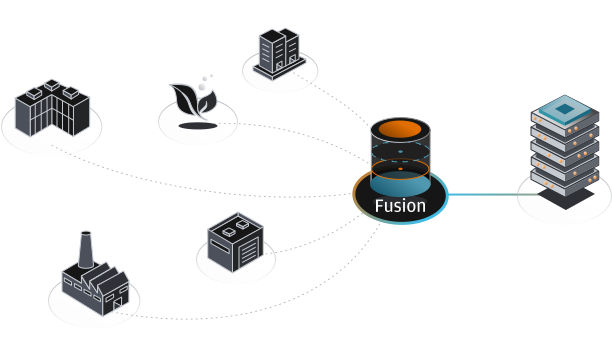
Asset owners address their data challenges and drive operational efficiencies with Fusion by J.P. Morgan, a cloud-native data platform that delivers end-to-end data management and reporting solutions. Fusion centralizes access to clean, interoperable data from J.P. Morgan and third-party data sources – something that is especially important given the convergence of public and private data. Fusion makes the data available where our clients want it. For technical users, it natively integrates with:
● Snowflake
● Databricks
● AWS
● Google's BigQuery
● Fund of fund strategies

For data scientists, there is a python SDK making the data easily accessible to Jupyter Notebooks, and for business users, Fusion Drive makes the data easily accessible directly to the desktop for use in products like:
● Excel
● PowerBI
● Tableau
Fusion captures and integrates public and private assets holdings and transactions data across asset classes, including:
● Public securities
● Private equities
● Private credit
● Real estate
● Venture capital
● Natural resources
● infrastructure
Fusion is also able to integrate data across multiple portfolio administrators, including J.P. Morgan Securities Services, to capture granular data attributes gathered through the investment workflows and enrich it with data from leading data vendors for private assets such as:
● Aumni
● Burgiss
● Canoe
● PitchBook
The resulting data is optimized, standardized, and comprehensive, so no granular detail is lost. Data processing is handled algorithmically, and updated automatically, providing access to the latest data without the need for manual processes. This, in turn, makes it easier to consume and operate at scale with growing data needs. Data discovery is simple in the Fusion Data Catalog, where it is possible to access data across asset classes, themes, and sources, including J.P. Morgan and other providers.
The public and private data are then normalized, formatted, and modeled, with standardized identifiers generated by Fusion’s advanced identifier (ID) synthesis algorithms. The proprietary data normalization engine, designed by the data experts at J.P. Morgan, models data with well-formed structures and applies standardized identifiers. Fusion’s continuous and proactive approach identifies inaccuracies and incompleteness, even as instrument identifiers evolve through listings of private companies and secondary transactions. Fusion’s identifier matching engine assigns consistent identifiers, thus normalizing, linking, and processing datasets to enable security mastering at the fund, investment, and asset levels. The resulting data is then ready for use, with full interoperability between public and private holdings.
The data on Fusion is interconnected through wellstructured relationships – that is, accurate and complete linkages between data attributes. These linkages clearly define the connections between data entities and their real-world associations, including their portfolio, constituents, and related instruments. The underlying asset look-though makes it easier to assess fundamentals and track details at the asset level. The Data Explorer feature of Fusion enables users to view and analyze the data, switch between multiple portfolios, and navigate across the linked datasets, including:
● Pricing data
● Private asset valuation
● Index and benchmarks
● ESG data
● Reference data
Our roll forward and bi-temporality offerings in Fusion help solve for lagged and unlagged returns catering to private assets reporting frequencies.
1 McKinsey Global Private Markets Review 2024, McKinsey & Company
2 Asset Allocation: Outlook 2024, Prequin
3 Global Financial Stability Report: Safeguarding Financial Stability Amid High Inflation and Geopolitical Risks, IMF, 2023
4 Investment Management Awakes: Data Has Its Day, Allocator
5 Pitchbook, as of 4Q 2023
6 NACUBO-TIAA Study of Endowments
7 A Private Equity Liquidity Squeeze By Any Other Name, Markov Processes International.
8 Investment Management Awakes: Data Has Its Day, Allocator
9 Investment Management Awakes: Data Has Its Day, Allocator
10 “Next Best Actions to Improve Your Data and Analytics Governance,” Gartner, December 9, 2022
11 “Private Equity Delivers the Strongest Returns for Retirees Across America: 2021 Public Pension Study,” American Investment Council, 2021
12 Dynamo Frontline Insight Report: Analyzing Trends, Identifying Challenges, and Harnessing Insights from Leading LPs & Asset Allocators, Dynamo Software, 2024
13 Asset Owner Transformation in 2023, ValueExchange
FOR INSTITUTIONAL & PROFESSIONAL CLIENTS ONLY — NOT INTENDED FOR RETAIL CUSTOMER USE This is not a product of J.P. Morgan Research. J.P. Morgan is a marketing name for the Securities Services businesses of JPMorgan Chase Bank, N.A. and its affiliates worldwide. JPMorgan Chase Bank, N.A. is regulated by the Office of the Comptroller of the Currency in the U.S.A., by the Prudential Regulation Authority in the U.K. and subject to regulation by the Financial Conduct Authority and to limited regulation by the Prudential Regulation Authority, as well as the regulations of the countries in which it or its affiliates undertake regulated activities. Details about the extent of our regulation by the Prudential Regulation Authority, or other applicable regulators are available from us on request. J.P. Morgan and its affiliates do not provide tax, legal or accounting advice. This material has been prepared for informational purposes only and is not intended to provide, and should not be relied on for, tax, Legal, regulatory or accounting advice. You should consult your own tax, Legal, regulatory and accounting advisors before engaging in any transaction. This document is not intended as a recommendation or an offer or solicitation for the purchase or sale of any security or financial instrument. Rather, this document has been prepared exclusively for the internal use of the J.P. Morgan’s clients and prospective client to whom it is addressed (including the clients’ affiliates, the “Company”) in order to assist the Company in evaluating, on a preliminary basis, certain products or services that may be provided by J.P. Morgan. This document is provided for informational purposes only and is incomplete without reference to, and should be viewed solely in conjunction with, the oral briefing provided by J.P. Morgan. Any opinions expressed herein may differ from the opinions expressed by other areas of J.P. Morgan. This document may not be disclosed, published, disseminated or used for any other purpose without the prior written consent of J.P. Morgan. The statements in this material are confidential and proprietary to J.P. Morgan and are not intended to be legally binding. All data and other information (including that which may be derived from third party sources believed to be reliable) contained in this material are not warranted as to completeness or accuracy and are subject to change without notice. J.P. Morgan disclaims any responsibility or liability to the fullest extent permitted by applicable law, whether in contract, tort (including, without limitation, negligence), equity or otherwise, for any loss or damage arising from any reliance on or the use of this material in any way. The information contained herein is as of the date and time referenced only, and J.P. Morgan does not undertake any obligation to update such information. J.P. Morgan is the global brand name for JPMorgan Chase & Co. and its subsidiaries and affiliates worldwide. All product names, company names and logos mentioned herein are trademarks or registered trademarks of their respective owners. Access to financial products and execution services is offered through J.P. Morgan Securities LLC (“JPMS LLC”) and J.P. Morgan Securities plc (“JPMS plc”). Clearing, prime brokerage and brokerage custody services are provided by JPMS LLC in the U.S. and JPMS plc in the U.K. Bank custody services are provided by JPMorgan Chase Bank, N.A. JPMS LLC is a registered U.S. broker dealer affiliate of JPMorgan Chase & Co., and is a member of FINRA, NYSE and SIPC. JPMS plc is authorized by the PRA and regulated by the FCA and the PRA in the U.K. JPMS plc is exempt from the licensing provisions of the Financial and Intermediary Services Act, 2002 (South Africa). J.P. Morgan Securities (Asia Pacific) Limited is regulated by the HKMA. J.P. Morgan Europe Limited, Amsterdam Branch does not offer services or products to clients who are pension plans governed by the U.S. Employee Retirement Income Security Act of 1974 (ERISA). For additional regulatory disclosures regarding these entities, please consult: www.jpmorgan.com/disclosures. The products and services described in this document are offered by JPMorgan Chase Bank, N.A. or its affiliates subject to applicable laws and regulations and service terms. Not all products and services are available in all locations. Eligibility for particular products and services will be determined by JPMorgan Chase Bank, N.A. and/or its affiliates. © 2024 JPMorgan Chase & Co. All rights reserved. JPMorgan Chase Bank, N.A. Member FDIC
Complete your access to Fusion or talk to our team about your data needs.